
Form 2: Risk Assessment
As an exhibitor, you have a legal requirement to assess risks appertaining to your participation in any exhibition. A risk assessment is a careful examination of what during the build-up, open days and breakdown of your stand, could cause harm or damage to any person who could come in contact with your stand, your stand staff or your sub-contractors during this period. This form is intended for guidance only and completion does not absolve you from your legal responsibilities or transfer them to CBS Arena or Foremarke Exhibitions Ltd.
You may use your own format for providing your risk assessment.
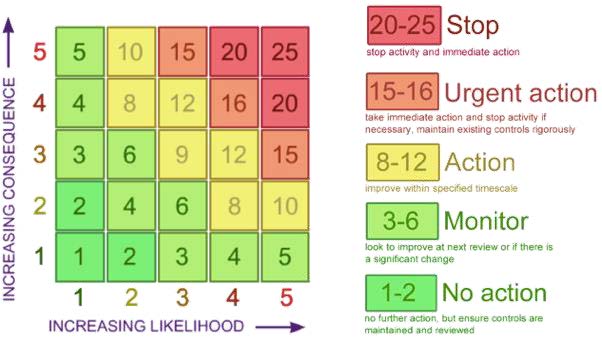
Below you may find a risk matrix for guidance.
Deadline: 23 October
RISK ASSESSMENT FORM
An assessment of risk is a careful examination of what could cause harm or damage to any person who could come into contact with your stand, stand staff, or your subcontractors during the build-up, open days or breakdown periods. Weigh up whether you have taken enough precautions or should do more to prevent harm. Here are four points for consideration to help you with the completion of your Risk Assessment.
1. HAZARDS
Look for potential hazards related to your stand, which, in the case of an accident, could be the cause of significant harm to somebody. It is very important that you think through what is happening on your stand and whether you, your staff, contractors and visitors are involved in, or affected by, anything that could harm them or others. If you do not consider that you have any hazards, please write ‘NONE’ in each relevant section of the form – do not leave them blank.
Here are some possible hazards, but you may think of others – please do not limit yourself to just these:
- Slipping / tripping (e.g. on loose carpet)
- Manual handling (e.g. setting up displays)
- Fire (perhaps from flammable materials on the stand Excessive noise Chemicals (e.g. cleaning fluids)
- Poor Lighting Moving parts of machinery (e.g. drills)
- Blocked gangways
- Work at height (e.g. when constructing the stand)
- Long working hours
- Electricity (e.g. loose wires from socket to computer)
- Waste (e.g. wrapping paper)
2. WHO MIGHT BE HARMED?
There is no need to list individual names – just groups of people, for example:
- Stand staff / Exhibitors
- Cleaners / venue staff
- Maintenance personnel
- Organisers
- People sharing your stand / space
- Contractors Members of the Public (e.g. Visitors)
- Delivery Companies
Pay particular attention to people who may be more vulnerable, including:
- Staff / visitors with disabilities
- Inexperienced staff,
- Lone workers
- Tired workers
- Foreign contractors
3. IS THE RISK ADEQUATELY CONTROLLED?
- Have you already taken precautions against the risk from the hazards, which you have listed?
- Have you already provided, for example, adequate information, instructions or training?
- Have you already provided adequate systems or procedures?
- Do the precautions meet standards set by a legal requirement?
- Represent good practice?
- Comply with a recognised industry standard?
- Reduce risk as far as is reasonably practicable?
4. WHAT FURTHER ACTION IS NECESSARY TO CONTROL THE RISK?
What more could you reasonably do to avoid those risks, which you found to be not adequately controlled? Give priority to those risks, which could affect large numbers of people or could result in serious harm. Apply the principles listed below when taking further action, if possible in the following order:
- Remove the risk entirely
- Try a less risky option
- Prevent access to the hazard (e.g. by putting up a guard screen)
- Organise work to reduce exposure to the hazard
- Issue personal protective equipment (e.g. hard hats)
- Provide welfare facilities (e.g. washing facilities for the removal of contamination)